
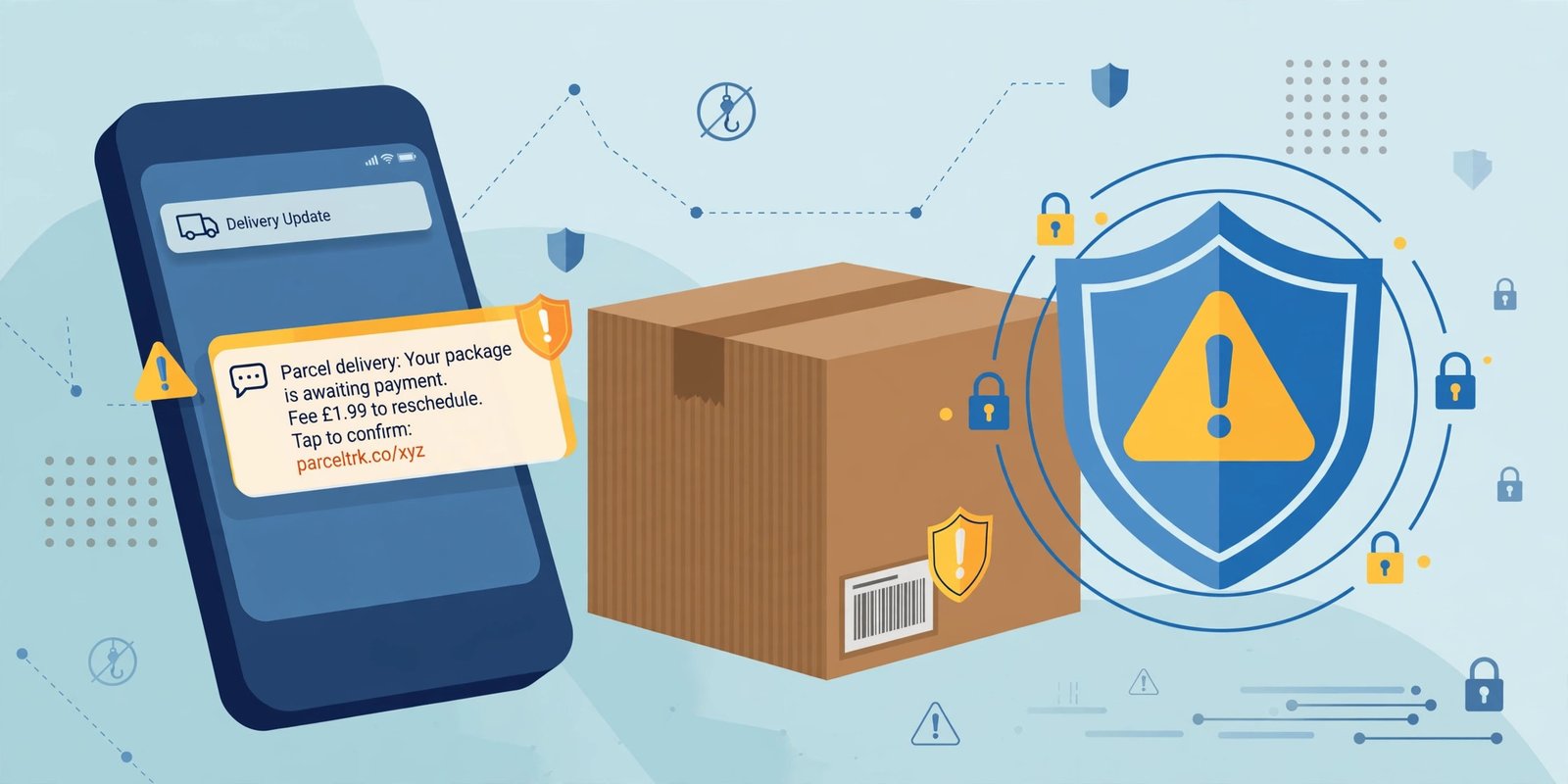
A parcel delivery text scam is a fake message that pretends to come from a courier. It usually claims that a parcel could not be delivered, or that a small fee is due, and it pushes you to tap a link straight away. The link leads to a fake tracking page that steals your card details or personal information. If a text about a parcel you were not expecting asks you to pay through a link, treat it as a scam until you prove otherwise.
1. What a parcel delivery text scam looks like
Scammers misuse the names of well known couriers, including Royal Mail, Evri, DPD, DHL and UPS. A typical message says that a delivery attempt failed, that an address was incomplete, or that a redelivery fee must be paid. It often includes a short link and a sense of urgency, such as a warning that the parcel will be returned if you do not act today.
The fake page that follows usually looks convincing. It may copy the courier colours and logo, show a tracking timeline, and ask for your name, address and card details to release the parcel. Some versions ask for only a small payment, such as one or two pounds. That small amount is the trap. Once you enter your card details, the scammers have what they really want.
These messages do not only arrive when you are waiting for a parcel. Scammers send them in bulk, knowing that many people shop online and that some will be expecting a delivery. A message that arrives out of the blue, or that refers to a parcel you cannot identify, deserves extra suspicion.
2. The red flags that give it away
Look for these warning signs before you tap anything. A message that shows several of them is almost certainly fake.
First, check the sender. Scam texts often come from a normal mobile number, or from a sender name that looks close to a courier name but is spelled slightly differently. A genuine courier message is still no guarantee on its own, because sender names can be spoofed, but an odd sender is a strong warning.
Second, watch for urgency and threats. Phrases such as act now, final warning, or parcel will be returned are designed to stop you thinking. Real delivery problems rarely need an instant payment by text.
Third, look at the link. Scam links often use shortened addresses, misspelled courier names, or extra words tacked onto a familiar name. Never judge a link by the courier name in the message text. The real destination is the web address behind the link, and scammers hide it for a reason.
Fourth, be suspicious of any surprise fee. If you ordered an item and paid for delivery at checkout, a courier should not suddenly demand a separate redelivery fee through a text link. If a fee were genuinely due, you would be able to confirm it through the retailer or the courier official channel, not only through a link in a text.
Fifth, check the language. Poor spelling, awkward phrasing, or a message that switches between formal and casual language can all point to a scam. That said, many scam messages are now well written, so good English alone never proves that a message is genuine. To understand the wider pattern behind these messages, read how smishing works in general.
3. How to check whether a message is genuine
Do not use the link or phone number in the text itself. That is the one rule that protects you in almost every case. Instead, check the delivery through a route you trust.
Start with the retailer. If you ordered something, check your order confirmation email or your account on the retailer website. It should show the courier name and tracking number. Compare that tracking number with the one in the text, if the text gives one at all.
Next, go to the courier official website or app directly. Type the address yourself, or open the app you already use, and enter the tracking number there. If the courier has no record of the parcel, the text is fake. If you are not expecting any parcel, you can stop there. Delete the message and move on.
You can also contact the courier through the contact details on its official website. Do not call a number given in a suspicious text. A short check through the official channel takes a couple of minutes, and it settles the question properly.
Finally, remember this simple test. A genuine courier does not need you to follow a link in an unsolicited text to pay a surprise fee. If the only proof of the delivery is the text itself, that is not proof at all.
4. What to do if you received one
If you have not clicked the link, you are already safe. Do not tap it, do not reply, and do not call any number in the message. Forward the text to 7726, free of charge, so your mobile provider can investigate it. You can also report it to report@phishing.gov.uk. Then delete the message and block the sender if your phone offers that option.
If the message arrived by email rather than text, forward it to report@phishing.gov.uk as well. Do not forward it to friends or post a screenshot publicly, because the link in it could still catch someone else out. Reporting it quietly to 7726 or to the phishing reporting service helps far more.
If you are unsure whether a parcel is real, use the checks in the previous section before you do anything else. A few minutes of checking beats a stolen card any day.
5. What to do if you clicked or paid
Act quickly, and do not feel embarrassed. These scams work because they look real, and they catch thousands of careful people every year.
First, contact your bank straight away using the number on the back of your card, or call 159 to reach your bank fraud team. Tell them what happened and ask them to block the card and check for further transactions. The sooner you report it, the better your chances of stopping extra charges.
Second, change any passwords you entered on the fake page, especially if you reused a password elsewhere. Start with your email account, because access to your email can unlock many other accounts. Turn on two factor authentication where it is available.
Third, report the scam to Report Fraud, the UK national fraud reporting service. Keep screenshots of the message and the fake page if you still have them, plus the date, the sender details and any payment reference. Those details help investigators spot the wider scam.
For the full recovery steps, including refund rules and how to lock down your accounts, see what to do after falling for a scam. Then watch your bank statements closely for the next few weeks, and stay alert for follow up messages. Scammers sometimes target the same people again with fake refund offers.
6. How real couriers handle missed deliveries
Real couriers normally leave a card, send an update through their own app, or update the tracking page you can reach from the retailer. They do not rely on a single text with a payment link. If you missed a delivery, the tracking page on the official courier site will say so, and it will offer redelivery or collection options without asking you to pay through a text link.
For Royal Mail items, redelivery and collection are arranged through Royal Mail official channels. For other couriers, the same principle applies. Always start from the retailer order or the courier official app, never from a link in an unexpected message. If a message claims to be from a courier you have never used, and you have no matching order, delete it.
FAQs
Is this Royal Mail text real?
Only check through Royal Mail official website or app, using a tracking number from your retailer order. If Royal Mail has no record of the parcel, or you were not expecting one, the text is fake. Forward it to 7726 and delete it.
Should I click the tracking link in a parcel text?
No. Never click a tracking link in an unexpected text. Go to the courier official website or app yourself and enter the tracking number there. That way you control the route, and a scammer cannot steer you to a fake page.
What number do I forward scam texts to?
Forward scam texts to 7726, free of charge. You can also report them to report@phishing.gov.uk. Reporting helps mobile providers block the sender and warn others.
What if I already paid on a fake parcel page?
Contact your bank immediately, using the number on your card or by calling 159, and ask them to block the card. Change any passwords you entered, starting with your email, and report the scam to Report Fraud.
Can a courier charge a redelivery fee by text?
Be very suspicious of any redelivery fee demanded only through a text link. Confirm any fee through the retailer or the courier official website or app before you pay anything. If neither can confirm it, do not pay.
Conclusion
A parcel delivery text scam works by combining a familiar courier name, a small fee and a deadline. Slow down, ignore the link, and check the delivery through the retailer or the courier official app instead. Forward suspicious texts to 7726, report them to the phishing reporting service, and act fast with your bank if you clicked or paid. Those few habits turn a convincing scam into a message you can spot and delete in seconds.