
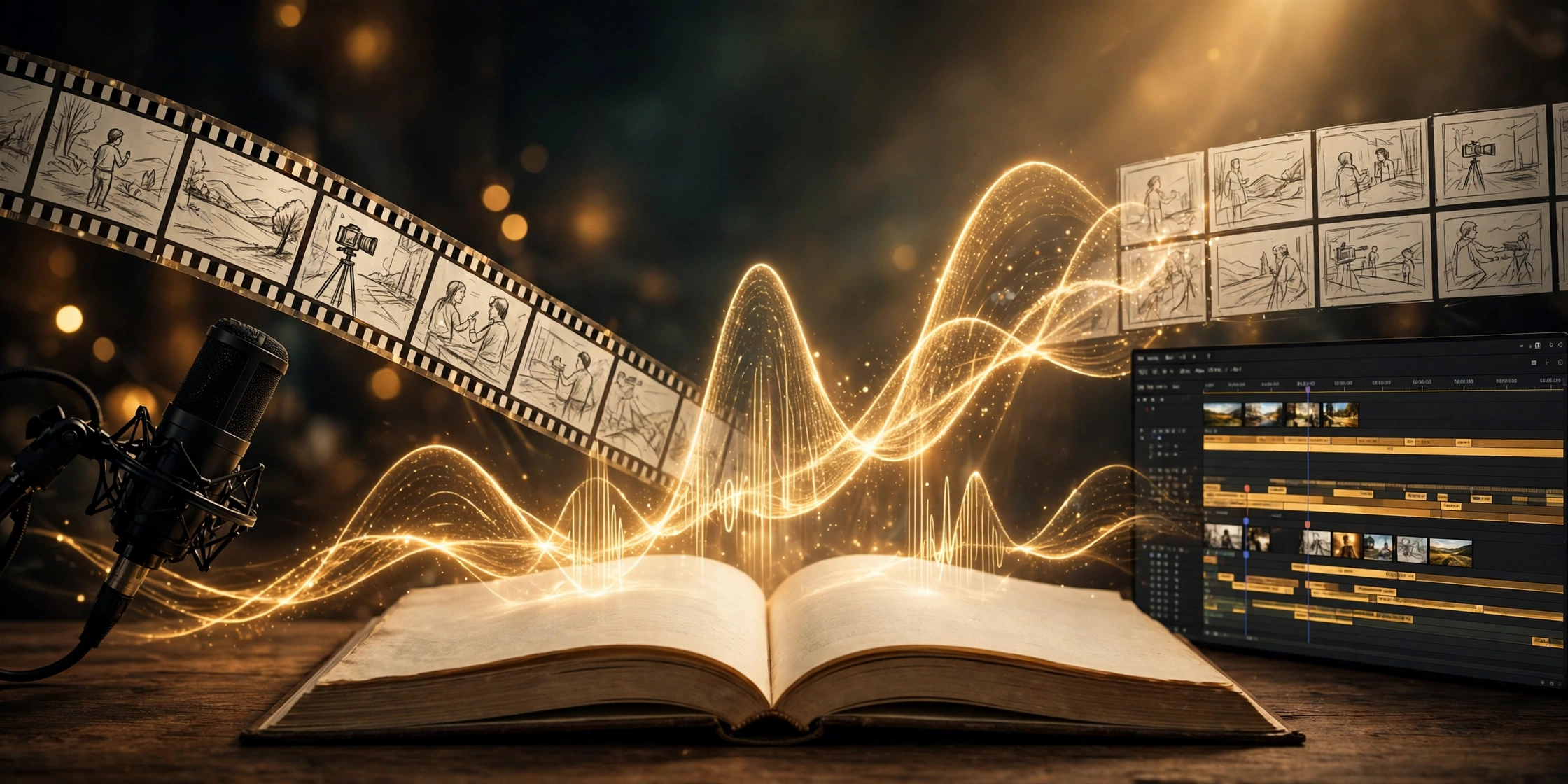
Can an audiobook become a film? Yes, and the pipeline is shorter than you might think. chapterframe takes an existing audiobook recording and builds a finished film timeline from it: scenes, characters, keyframes and storyboards, all synced to the original narration. Because an audiobook already contains the script, the pacing and the performance, it is unusually good raw material for AI-generated film.
Why an audiobook is the perfect raw material
Most AI video tools start from a text prompt. That works for short clips, but a film needs structure. A prompt is a paragraph. An audiobook chapter is ten thousand words with timing, emotion and emphasis baked in. The narration tells you where each scene starts, which character is speaking and how the mood shifts. In other words, the hard directorial decisions are already on the tape.
That is the insight behind Chapterframe. Instead of asking you to describe your story in prompts, it starts from the recording you already have and treats it as the backbone of the film.
From import to finished timeline: how it works
The workflow follows five stages. Each one maps to something a human film crew would do, only faster.
1. Import your chapter
You upload a recorded chapter, usually as MP3 or WAV. The tool analyses the audio: speech timing, pauses, energy. Those pauses matter, because a pause in narration is a cut point in film.
2. Scene breakdown
The chapter is split into scenes based on the story beats in the narration. A change of location, a new character entering, a shift in tension: each becomes its own scene. You get a shot list without writing one.
3. Characters that stay consistent
This is the part older tools got wrong. Early AI video generators could make a beautiful character in one frame and a different person in the next. Modern pipelines use reference keyframes to lock in faces, clothing and proportions across scenes, so your protagonist still looks like your protagonist in chapter twelve. Competitors such as Reelmind approach the same problem with what they call keyframe sync, and the whole industry now treats consistency as the key feature to watch.
4. Keyframes and storyboards
For each scene, the system generates keyframes: the hero images that define the look of the shot. You review them as a storyboard, swap the ones you do not like and regenerate only those. You stay in the director’s chair. chapterframe for mac
5. A finished timeline, synced to the original narration
The final video is rendered against the original narration track. Dialogue lands where the narrator said it. Music and sound effects follow the story beats. What you get is a film timeline, not a pile of clips.
Who this is actually for
Three groups get the most out of it.
Authors
Book trailers used to cost thousands. Now an author can turn the first chapter into a trailer that looks like a real production, and post it everywhere the book is sold. Marketing is the most common first project, and it is the cheapest to test.
Narrators
If you already record audiobooks, you already own the hardest asset. A visual version of your catalogue opens up video platforms where audio alone cannot compete. And since fake AI narration is a genuine risk for voice professionals, it is worth knowing how easily recorded voices can be misused. Our guide on spotting AI voice cloning scam calls explains the warning signs.
Indie publishers
A small press cannot shoot a feature, but it can release a filmed edition of a backlist title. That is a new product, not just a marketing asset, and it can be sold alongside the audiobook.
What it costs compared to the traditional route
A modest animated short can cost tens of thousands of pounds to produce with a studio. An AI pipeline brings that down to software pricing: the rendering is the product, and your main investment is the time you spend reviewing storyboards. Be realistic, though. AI film still needs human taste. The tools do the drawing, but you do the directing, and audiences can tell when nobody did.
How Chapterframe compares to the alternatives
It is worth knowing the landscape. HeyGen builds video around narration for audiobooks and long-form stories. Mootion turns audio narration into synchronised video with scenes and transitions. Reelmind focuses on style presets and batch generation for audiobook adaptations. These are serious tools, and they keep improving.
Chapterframe’s pitch is the end-to-end film timeline: not a clip generator or a repurposing tool, but a pipeline that treats your chapter like a screenplay. If your goal is short social clips rather than a film, a repurposing tool like Opus Clip does something adjacent for finished video; our Opus Clip review looks at what it actually does. Choose based on what you are making.
Frequently asked questions
Q: Can I really turn an audiobook into a film without filming anything?
A: Yes, for the visual track. You still need the audiobook recording itself, and you will want to review every scene. But no cameras, no sets and no actors are required.
Q: Do I need video editing skills?
A: No. The workflow is built around reviewing storyboards and approving scenes, not timeline editing. If you can listen critically to your own chapter, you can direct the result.
Q: Who owns the finished film?
A: That depends on the terms of the tool you use and the rights in your audiobook. If you narrated it or licensed the narration, you are in a strong position. Always read the licensing terms before you publish.
Q: How long does one chapter take?
A: The rendering runs in the background while you review. Most of your time goes into the storyboard review, which is the part worth doing carefully.
Q: Will it look like a real film?
A: It will look like an AI film: stylised, consistent and getting better fast. Set the style deliberately, whether cinematic, watercolour or something else, and own the aesthetic.
The bottom line
An audiobook is already a film waiting to happen: script, pacing and performance, all finished. Chapterframe exists to turn that raw material into moving pictures without a studio budget. If you have a finished recording and a story worth showing, the only missing ingredient was the pipeline. Now there is one.