
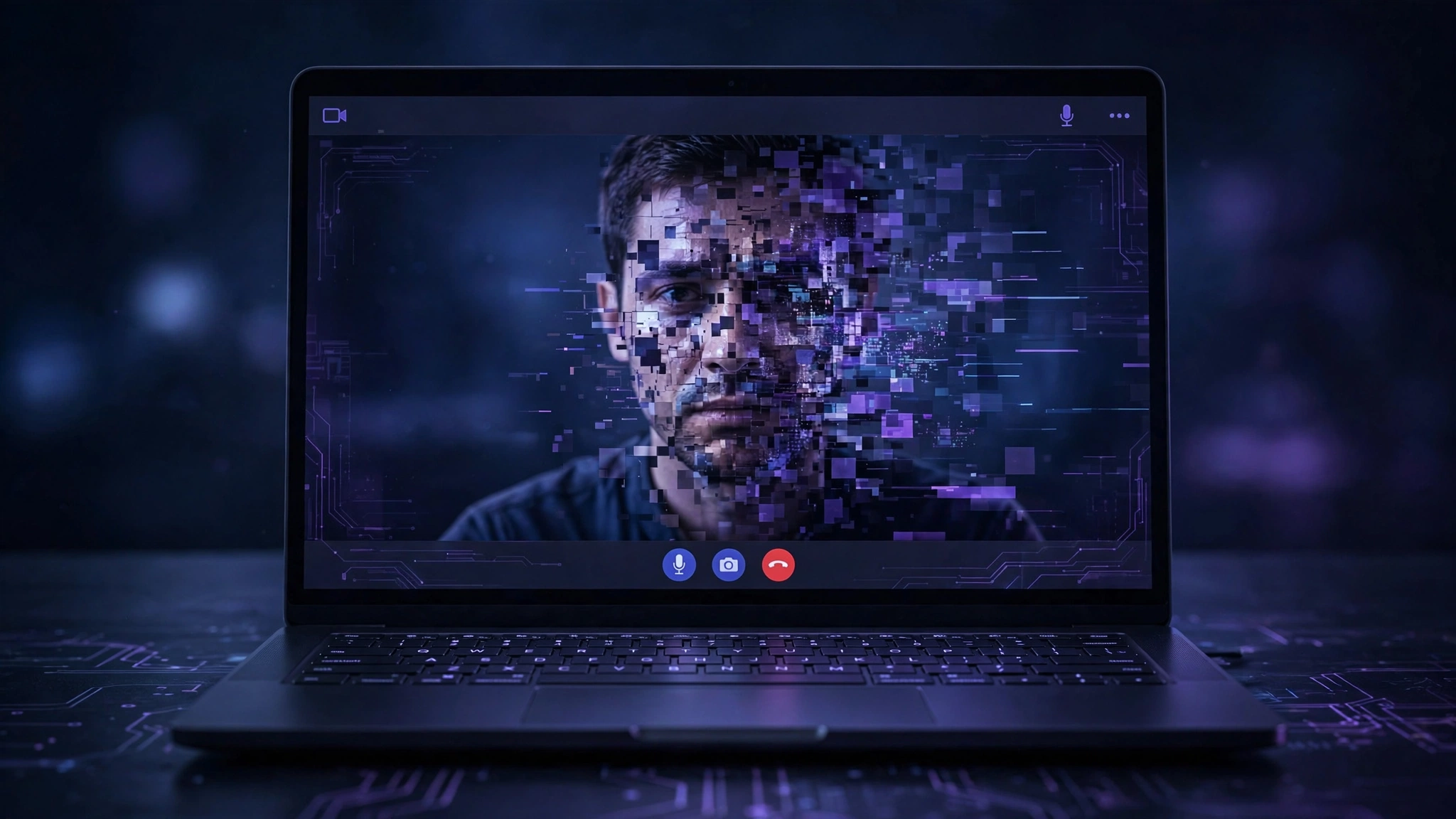
A deepfake video call scam uses AI to fake the face and voice of someone you trust on a live video call. The caller may look like your boss, a family member, or a colleague. They press you to send money or share sensitive details. Here is how these scams work, and how to stay safe in the UK.
What is a deepfake?
A deepfake is a fake video, image, or voice created with artificial intelligence. The software learns how a real person looks and sounds from photos and video clips. It then maps that likeness onto new footage, in real time.
Deepfakes used to need expensive equipment and weeks of work. That has changed. Modern tools can build a convincing fake face from a few minutes of public footage, such as interviews or social media clips. Criminals now create these fakes from material that is freely available online.
How criminals get the material to fake you
Every video of you online is raw material for a deepfake. Public social media videos, company conference recordings, webinars, podcast appearances, and news interviews all work. Criminals collect these clips, train the AI on your face and voice, and then appear as you on a live call.
You cannot remove yourself from the internet completely. But you can reduce your exposure. Set social media videos to friends only where possible. Ask colleagues to think twice before posting full recordings of meetings with named attendees. The less public footage of you there is, the harder you are to fake.
How a deepfake video call scam works, step by step
1. The set up. You get a message from someone you know, or from a senior figure at your company. They ask you to join a video call about something confidential and urgent.
2. The call. You join and see the person you expected, plus sometimes colleagues you recognise. They look and sound real. The conversation flows naturally.
3. The pressure. The callers stress secrecy and speed. They tell you not to tell anyone else. They want a decision before you have time to think.
4. The demand. You are asked to transfer money, approve payments, or share login details. The accounts you pay into are controlled by the scammers.
5. The discovery. The scam usually comes to light only when the real person is contacted through a different channel. By then, the money has already moved.
A real example: the 20 million pound Arup scam
In 2024, British engineering firm Arup confirmed it had lost HK$200 million, roughly 20 million pounds, to a deepfake video call scam. A finance employee in Hong Kong was invited to a video call by someone posing as the company’s chief financial officer. On the call, the employee saw and heard what looked like the CFO and several colleagues. Every one of them was a deepfake.
The employee authorised 15 transfers to five Hong Kong bank accounts before the fraud was discovered. Arup said it went public about the incident to raise awareness of how sophisticated these attacks have become.
Ordinary people are targeted too. Criminals have faked the faces and voices of family members to claim a loved one is in trouble and needs money urgently. You do not need to be a company executive to be at risk.
Why people fall for it
Seeing is believing. A face on a video call carries enormous trust. Most people have never met a convincing deepfake, so they do not look for one.
Authority. The caller poses as a boss, a senior colleague, or a relative. People hesitate to question authority figures.
Urgency. Pressure to act fast shuts down careful thinking. Scammers know this and use it deliberately.
Social proof. When several familiar faces on one call all agree, doubting them feels unreasonable.
Secrecy. Telling you to keep the call confidential cuts you off from the one thing that would stop the scam: a second opinion.
Red flags that give the scam away
The call came out of nowhere. It was arranged only by message, with no normal context around it.
The video looks slightly wrong. Watch for glitches around the face or mouth, or odd movement when the person turns their head. But modern fakes are getting cleaner, so do not rely on this alone.
The audio and lip movements do not quite match. Small delays or mismatches are a warning sign.
The caller avoids personal questions. They refuse to continue the conversation on another channel, or dodge anything only the real person would know.
You are told to keep everything secret. Genuine urgent requests from real colleagues do not need secrecy from the rest of the team.
Money or sensitive details are requested urgently. This is the core of the scam. Urgency is the tool, not the reason.
Important: a call with no visible glitches can still be fake. Never rely on a single sign.
How to verify a suspicious video call
Pause the conversation. Do not send money or share details while you are still on the call.
Contact the person through a separate channel. Call their real number, or message them on an account you already trust. Never use contact details the caller gives you.
Ask a question only the real person could answer. Even better, agree a family code word in advance with the people closest to you. If a supposed relative calls in trouble, ask for the code word before you act.
For work payments, follow your normal approval process. No video call should override it, however urgent it feels.
Scammers also fake voices on ordinary phone calls. Learn how to spot AI voice cloning scam calls so you are protected on every channel.
What to do if you already paid or shared details
Contact your bank immediately. Use the number on the back of your card, or dial 159, the Stop Scams UK service that connects you directly to your bank’s fraud team. The faster you report, the better the chance of recovering the money.
Report the fraud to Action Fraud. Action Fraud is the UK’s national fraud and cyber crime reporting centre. Report online at actionfraud.police.uk or call 0300 123 2040. In Scotland, report to Police Scotland on 101.
Lock down your accounts. Change your passwords, starting with your email account, and turn on two factor authentication everywhere you can. Also check whether your email was exposed in a data breach, and change passwords on any exposed accounts.
Keep evidence. Save screenshots, phone numbers, account details, and the messages that set up the call. The police and your bank will need them.
Warn the person who was impersonated. They may not know their identity is being abused. Also tell your bank about any follow up contact. Criminals often target scam victims again with fake recovery offers.
Frequently asked questions
Can a deepfake really work on a live video call?
Yes. Modern AI can swap a face and clone a voice in real time during a live call. The quality is now high enough to fool people who are not expecting it.
How can I tell if a video call is a deepfake?
Look for odd glitches around the face and mouth, mismatched lip movement, or strange lighting. But the honest answer is that visual checks are not enough. The only reliable test is to verify the caller’s identity through a separate channel.
What should I do if my boss asks for money on a video call?
Pause. End the call politely. Then contact your boss using a number or channel you already trust, and check whether the request is real. Never skip your normal approval process because a call felt urgent.
Are deepfake scams illegal in the UK?
Yes. Using a fake identity to trick someone into sending money is fraud, which is a criminal offence under the Fraud Act 2006. Report it to Action Fraud and your bank.
How can I protect my family from deepfake scams?
Agree a secret code word with family members now. If someone calls claiming to be a relative in trouble, ask for the code word before you act or send money.
The bottom line
Deepfake video call scams work because they exploit trust, not technology. The defence is simple and old fashioned: slow down, and check through a channel you trust. No genuine request for money is so urgent that it cannot survive a five minute verification call.